

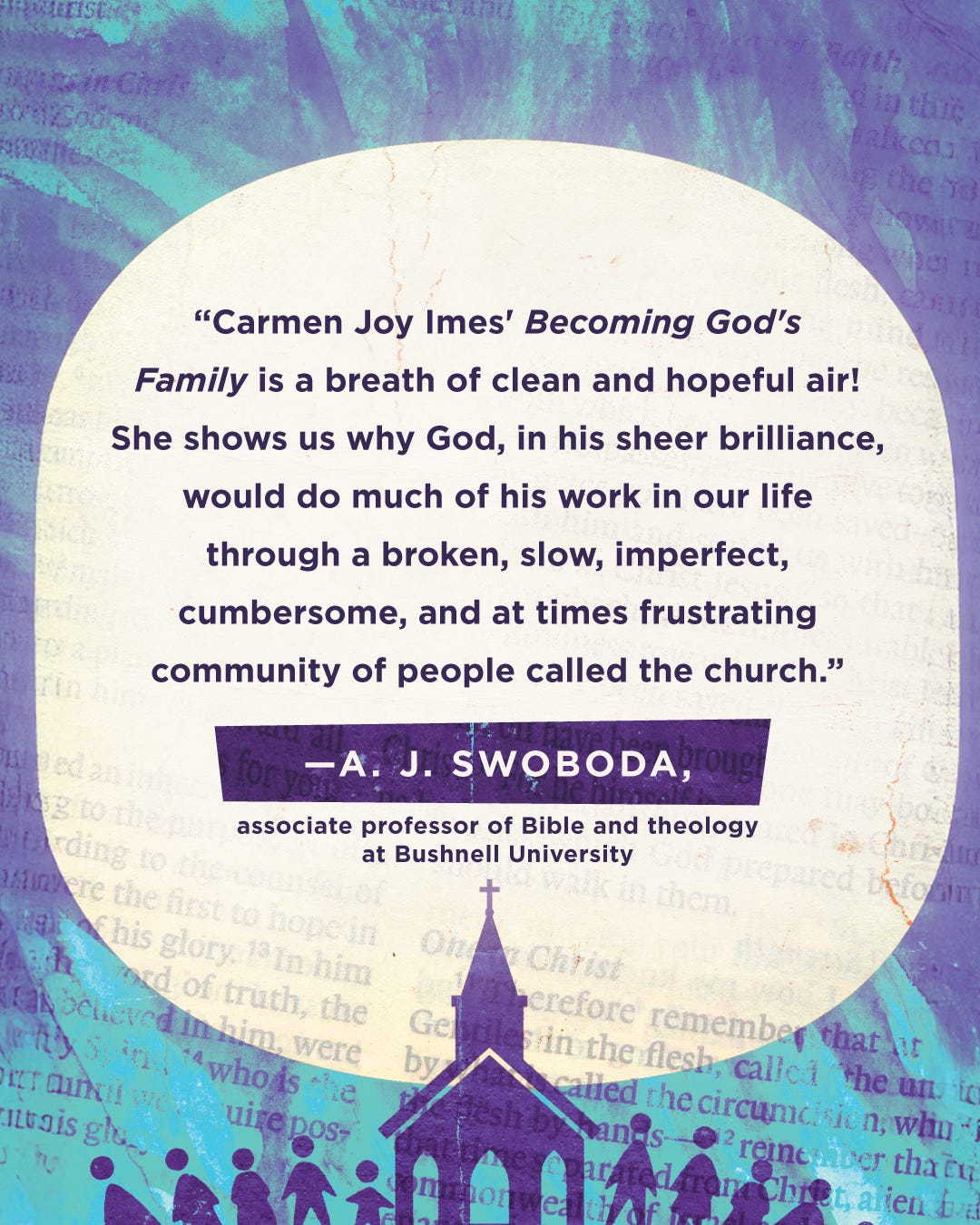
Hey friends, Nijay here. I’m excited to have Dr. Carmen Imes on Engaging Scripture here today to share some themes and ideas from her new book Becoming God’s Family: Why the Church Still Matters. This is a crucial time in history to recognize the importance of how much we need our spiritual community, the body of Christ.
Why We Need the Church Now More Than Ever
Aging in a Digital World
Guest Writer: Dr. Carmen Joy Imes

Becoming Obsolete
I had just spent the long weekend with my parents, watching each of them in turn navigate the cruel parts of aging whereby the ground shifts beneath your feet. My dad has a form of dementia that makes his cell phone a black box of mystery most days, and his TV a fickle companion, sometimes delivering channels and sometimes white snow that is anything but quiet. No amount of button pushing or cord switching seems to fix his problem. My mom is fully independent and in good health, but the frustrations of aging are close at hand every time she tries to place an order online.
Precisely at the points when being older should give you some advantage borne from experience, older adults find that their ways of navigating the world are no longer even possible. A lifetime of seasoned knowledge becomes obsolete with every new fangled app, with every layer of two-step verification—every one of which is so maddeningly and ironically impersonal.
It used to be that you could walk into a store, ask the owner how business was going, hear about their kids, get expert advice about the right brand to use for your project, pay in cash, and walk away with more than a product. In the old world, we walked away knowing our place in the world and feeling connected.
Now our faces are lit with the glow of a screen instead of the joy of recognition, as we scramble to find our login and password for the site with the best deal and the fastest shipping. We feed our contact information to a machine that will never love us back. Does the bewildering number of choices distract us from noticing the ache of unmet need for connection with another human? Circuit boards are not nearly as satisfying as smiles.
Perhaps that’s why I felt the woman’s angst as if it was my own. Having just arrived back from my trip to Colorado, I stood behind a white-haired woman at a restaurant in Los Angeles as she eyed the large touch screen on the drink dispenser, an empty cup in her hand. The screen presented her with only one option: a blue circle that simply read “water.” Her eyes searched, her hesitant hand half raised until she noticed an arrow in the corner, which she tapped uncertainly. I heard her startled expression as the screen filled with more drink options than her childhood grocer carried on his shelves. Her hand dropped as she drew back with a sigh.

I leaned forward on a rescue mission. “Can I help you find your drink?” She barely tipped her head in my direction, still overwhelmed by the choices in front of her. Finally, she found what she was looking for: Sprite. But when she tapped the icon, it spawned seven flavors of Sprite. Her arms fell and I groaned alongside her. I offered my sympathies: “Ugh. Why does everything have to be so complicated these days?!” In a few moments she had located plain-ole Sprite, figured out how to dispense ice, and filled her drink cup.
“Well done!” I smiled, as she moved over to find her lid and straw. I tapped the screen to navigate back to the water button and filled mine. Her mission accomplished, she turned to me with fresh confidence. “You just made my day!” Her eyes sparkled. “It’s been such a long day, and your smile made all the difference.”
In a few moments, she was back at her table with her grandson, her dignity restored.
It didn’t take much. It cost me nothing but attention and a sliver of empathy. We just need to be reminded that we are not alone. That someone sees us. That we are not obsolete.
Making Eye Contact
Theologically, the church matters for a lot of reasons. It’s God’s plan A to form us into an intergenerational and multicultural family of those who worship our Maker, hear the word preached, and carry on his work while we wait for Christ’s return. Together we feast at Christ’s table, united into one family.
But in the world we inhabit, the church also offers us a rare opportunity for human connection. Just making eye contact with fellow travelers eases the incalculable burden of loneliness. Church may be one of the least digital spaces we inhabit in a week’s time. No laptop. No phone. No automatic reminders or deadlines or requests. At church we practice the rare art of being fully present to God and to each other.
We sing the same songs. Listen to the same message. Share the same symbolic meal. Pray together. And Lord knows we need it. After a week of self check-out, GrubHub, Door Dash, and Amazon deliveries, we gather aching for genuine interaction.

Some years ago the surgeon general announced an epidemic of loneliness in the United States. The best antidote I know is to become entangled with others in healthy ways by embedding ourselves in a church community who will notice when we’re missing and whose eyes will light up when we walk through the door.
Shared Attention
Something powerful happens when we give shared attention to something that matters. Singing in unison calibrates our commitment to common truths. Hearing the Word read aloud reminds us of our shared heritage. In an age where we’ve become accustomed to multiple screens with multiple tabs open at once, to “go analogue” for 90 minutes with a whole room full of people is a breath of fresh air, reminding us that of our embodied lives.
If we’re committed to keeping the Sabbath, then we can silence the siren call of the to-do list and the pressure to produce and be fully present with each other. Under these conditions, the commodification of time—and each other—gives way to a taste of new creation rhythms.
Some time ago I was waiting my turn at the prefreshments table at church (donuts and coffee before the service, affectionately called “prefreshments”). In front of me was a six-year-old girl making hot chocolate. Her dad tried to hurry her along so that I could have a turn at the table. “No worries!” I told them, “I’m in no hurry.” His response startled me.
“You’re never in a hurry,” he said gratefully as he moved to help his daughter. My eyes widened. Efficiency is one of my chief values. I’m the queen of multitasking and I pack as much as I can into a given day. My default walking speed is brisk. My husband won’t even walk with me unless I agree to slow down.
That’s when I realized that this brother in Christ only ever saw me on Sundays, when I’ve relaxed into Sabbath rhythms. Being present is my aim, and with no to-do list dogging me, I have plenty of time to wait my turn. I hadn’t realized how much Sabbath changed me until that moment.
I need Sabbath like I need community. The church offers both. And as I bring myself to it, I find what I cannot find anywhere else: the presence of Christ among us.
Check out Dr. Imes’s new book, Becoming God’s Family: Why the Church Still Matters (Oct 28, 2025, preorder now).

Yes—this resonates deeply. I’ve written about how, for me, the church’s redemption won’t come through its platforms or power but through the kind of quiet holiness you describe here—through people who still make eye contact, still stop to notice, still bear Christ’s presence in ordinary acts of care.
In my own reflection below, "I Was About to Quit the Corrupt Church—Then I Saw Her," I write about an elderly immigrant woman at my church who embodied that kind of grace: a living reminder that the Spirit hasn’t abandoned the church, only relocated it to the margins. Your reflection captures that same truth—the sacred possibility of community, even now, when we slow down enough to see one another.
https://ericksierra.substack.com/p/i-was-about-to-quit-the-corrupt-church
Absolutely beautiful