


The Story Behind My Books
This series (inspired by Mike Bird’s Substack series on his previous work) is called “The Story Behind My Books” (2010-2025). Fifteen years is a good time for a rear-view mirror perspective. I offer stories about how the book came to be and my thoughts now as I look back.

Book #10: Paul and the Language of Faith
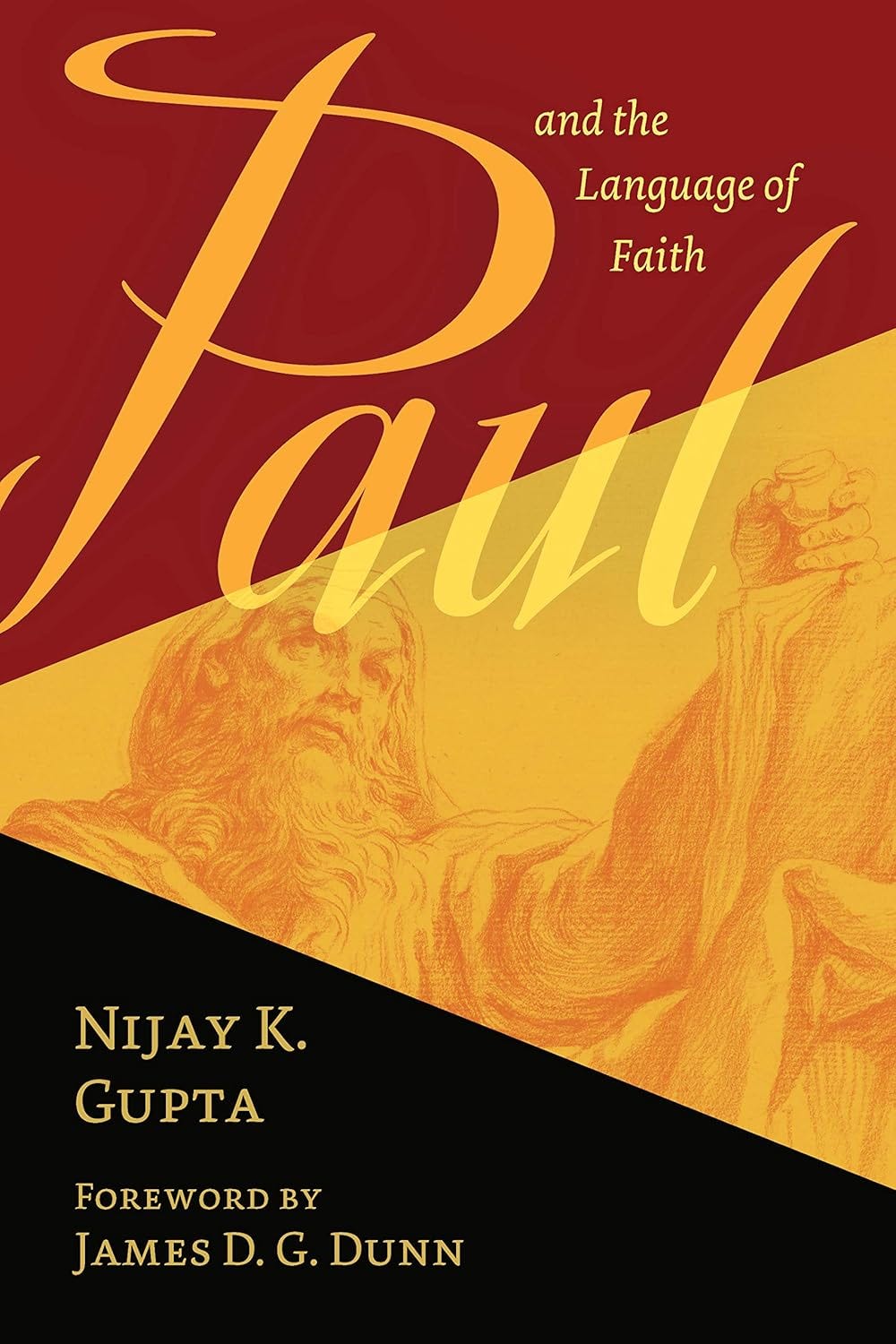
This is probably one of the books I am most proud of from my personal library. Ever since I started seminary (2001), I dreamed of publishing a monograph with Eerdmans. Eerdmans has long been a leading academic publisher: NIGTC, the NICNT. Two Horizons. Jimmy Dunn’s magisterial The Theology of Paul the Apostle. Gorman’s Cruciformity. Doug Campbell. Susan Eastman. N.T. Wright. Barclay’s Paul and the Gift. Absolute legends.
But how in the world could I get on their radar? It began with a friendship I had struck up with then-Eerdmans editor, Michael Thomson. When I first met Michael, he was going through some challenging life stuff, and so was I (my daughter was going through chemo). I remember we had breakfast at SBL in a hotel restaurant. Typically, you “talk shop,” but we ended up talking about how messy life was and how much we loved our children. “Work” takes a backseat to family. Eventually in the conversation, Michael asked me if I was cooking up any book ideas. I had one: I had been asked to write a dictionary article on “faith” covering the whole Bible. I was shocked when I discovered how few monographs there were on faith language in the Bible (other than on the Pistis Christou debate).
When I had done my own primary research, it was clear that in both non-Jewish Greek texts as well as Jewish texts the term pistis (often translated “faith”) had a wide range of meaning, including cognitive processing (belief), embodied loyalty (allegiance), and the operation of the will (trust). Commentaries rarely took this into consideration.
Also: I noticed that Hellenistic Jews felt very comfortable using pistis and related terms to talk about their piety; in fact, it could be used as a way to talk about covenant (see esp Josephus). That means that “faith language” didn’t start with Paul—he was building upon a hellenistic Jewish tradition that was deeply influenced by choices made in the Septuagint. Where we do see distinctives of faith language in Paul is the orientation of covenantal faith towards Messiah Jesus.
A highlight of publishing this book was having my friend and mentor James (aka “Jimmy) Dunn write the foreword. It was only a short while after this that he passed away. Jimmy’s work has had a massive impact on my scholarship and writing. I am so glad I got to know him.
Paul and the Language of Faith was published only a few months before the pandemic. In the first year or so of the pandemic, academic books took a huge hit. People were stressed out and distracted and exhausted; I think pop-level books continued on pretty steadily, but perennial academic works (not “hot topic”) were just not on people’s radars. That was a bummer. But as things started to settle down, I saw more and more reviews of my book. Insofar as I was defending or supporting the “New Perspective on Paul,” there were clear detractors. But overall the book was well-received.
At SBL 2019, I was honored to have a review session in the Pauline Theology group. Presenters included Esau McCaulley, Steve Fowl, and Jeanette Hagen Pifer, with Erin Heim as chair.

My good friend Prof. Peter Oakes (and his wife) came to support me.

I am honored that both Portuguese and Korean editions were later published.
I thought this book was amazing and did a whole message series using it as a primary resource.
Very useful resource - in combination with Teresa Morgan’s ‘Christian Faith’ …